
Pima County Arrest Log Sources
Start with the biggest limitation. The Pima County Sheriff's Department publishes no 72-hour booking log, no weekly roundup, and no dated multi-day arrest archive. What PCSD does offer is a current-custody roster. That roster shows who is in jail right now, but it is not an archive. Names fall off after release. Some entries linger from bookings that began days earlier. There is no roll-off archive and no stated posting schedule for it.
The local stand-ins each fill a narrower slice. Marana posts selected police press releases. Oro Valley publishes media releases and keeps a daily information log that media can request through a sergeant. The Ajo Copper News prints a Sheriff's Log built from PCSD records. All of these can name arrests. None is a complete Pima County blotter.
Read the Pima Arrest Blotter
Approach every Pima arrest record by its source and its date, never by an assumed seven-day window. Decide first what you actually want. Is it current custody at the jail, a city incident, a news account, or an older official record? Each question leads somewhere different. Keep the publishing agency and the event date separate in your notes. A release can go public days after the arrest. It can stay online long after release.
- Search the PCSD Inmate Lookup when present custody at PCADC is the key question.
- Use the Marana or Oro Valley release archive for a selected incident handled by that department.
- Check Ajo Copper News by issue for an Ajo-area sheriff log entry.
- Compare names, dates, agency, location, and case references rather than relying on a headline.
- Request the police, jail, or court record from the office that created it when the published window ends.
Fresh bookings are a different question entirely. The Pima County 24 Hour Arrests page tackles that same-day angle. It explains the lag. A brand-new arrest may not show up anywhere yet. This page stays on the multi-day and archival trail instead.
Pima Arrest-Log Entry Fields
The sources here are not one database. No shared entry schema exists. A news brief carries very different fields than a jail booking file, and a compact comparison keeps the two from being confused. Field details still vary by roster.
| Possible item | How to interpret it |
|---|---|
| Name | May identify an arrested or cited person; verify spelling with the originating record. |
| Event or arrest date | Can differ from the publication date and booking date. |
| Agency | Shows who reported or handled the event, not necessarily who holds the person now. |
| Location | May describe an incident area, arrest site, or custody location. |
| Alleged charge | An charge that may change after prosecutor and court review. |
| Booking or case reference | A route to a jail or court record when supplied. |
| Photo | Selective media imagery is not proof of a current PCSD booking-photo policy. |
| Outcome | Usually belongs in a later court disposition, not the initial blotter item. |
The PCSD roster is the richest single view. For anyone in current custody it lists name, age, booking details, and location. Total bond appears there too. It also shows a reference number, court, bond type, and bond amount. What it does not provide is a full charge narrative. There is no booking timestamp and no booking photo either. Those gaps do not close just because a news story adds color around the arrest. The roster answers who is in custody, not the whole story.
Pima City Police Release Archives
Marana runs a Police Press Releases category with dated public-information posts. Selected arrests appear there. It is an official municipal source. It never claims to list every police contact or every booking in town. A release might confirm that a person was taken to Pima County Jail. Current custody stays with the PCSD roster. The case outcome belongs to the courts. The Marana Police release filter shows the dated archive format.
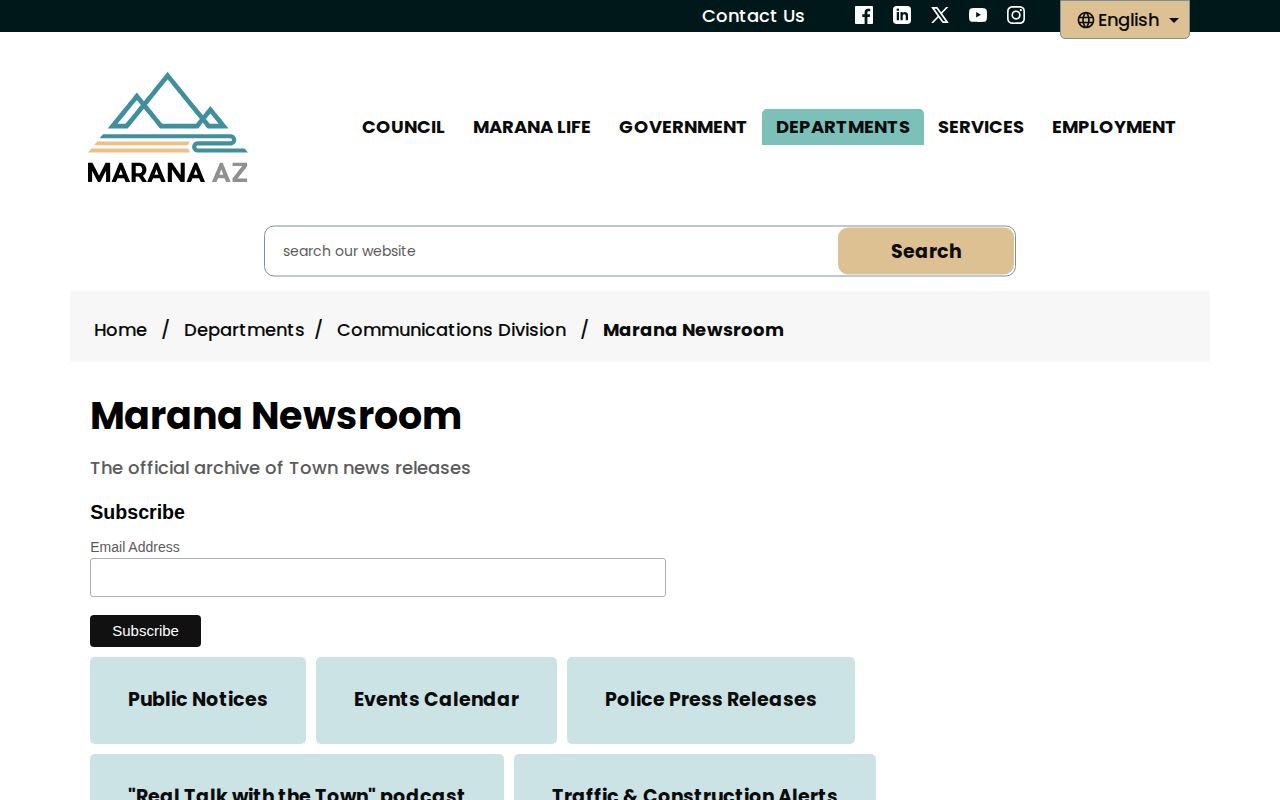
The Marana archive works well for notable incidents. Its selections are not a town-wide arrest count, so treat them as highlights. Oro Valley takes a similar approach. It publishes police media releases rather than a public daily arrest roster. Its internal daily information log exists under department policy. It reaches the public only through a media request. Web releases stay accessible and add incident context, but jail custody remains PCSD's territory. The OVPD Police Media Releases page holds that selective archive.
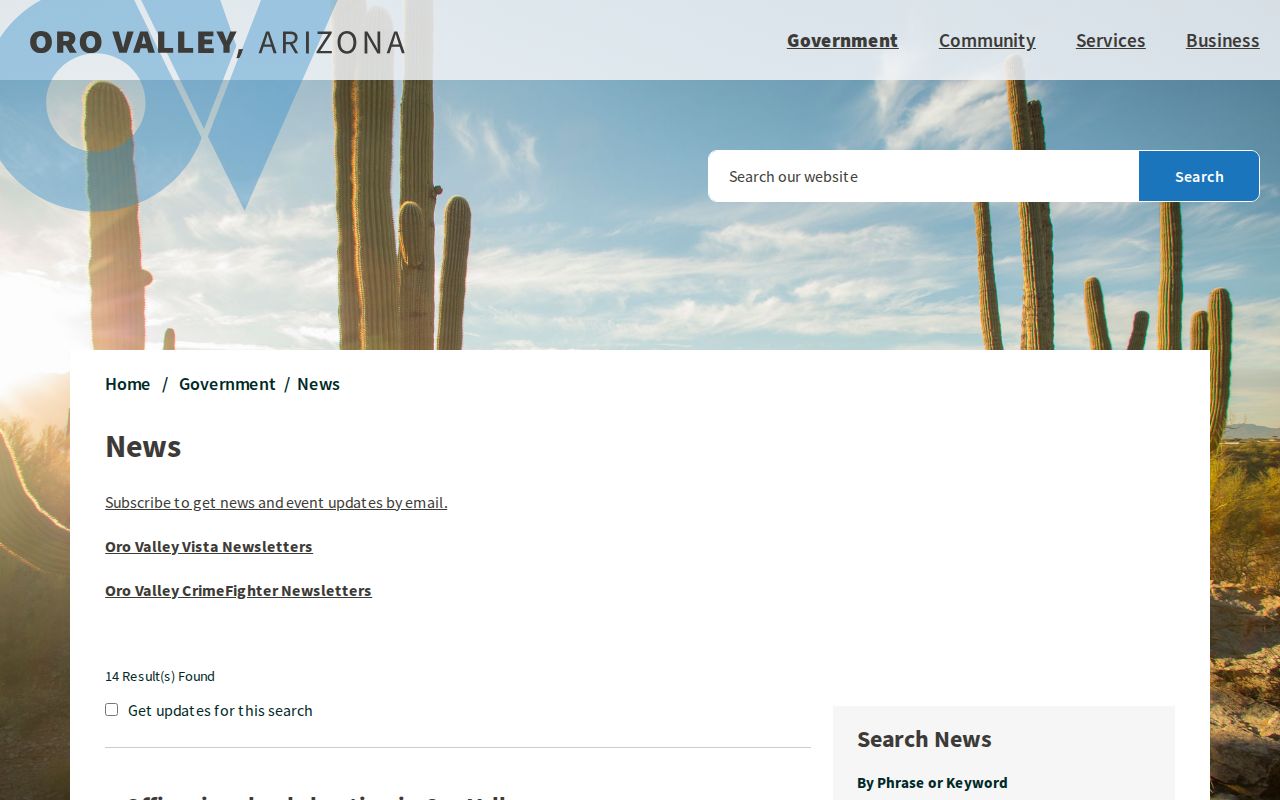
This screen searches city events. It does not list every Oro Valley arrest. Treat it as one piece of a wider record. Coverage stays selective.
Ajo's Issue-Based Sheriff's Log
Ajo Copper News offers the county's most distinctive blotter substitute. Its issue PDFs can carry a recurring Sheriff's Log. The log is drawn from PCSD public records. Items are short. They cover calls, citations, arrests, and other activity around Ajo and nearby communities. Publication follows the newspaper's issue schedule, so nothing there is live. Nothing is promised on rolling depth, and a booking photo is unlikely to appear. The Ajo Copper News site opens the issue-based archive.

The paper's real value is regional context that outlasts the event. PCSD and the courts still control custody and case status. Beyond Ajo, other outlets cover selected Pima County events. KOLD keeps a crime video index. KGUN9 runs local news, and Tucson.com hosts crime and courts pages. Their reports lean on scene images, file photos, or agency-supplied material. None promises every booking or a steady daily cadence. Treat news as a discovery tool, not the official arrest record.
Pima Weekend Posting Patterns
Weekends create delays of every kind. A city may hold a statement until investigators or a public-information officer sign off. A newspaper item simply waits for the next issue. Courts post filings on their own cycle. None of these gaps tells you a number. It cannot say how many people were arrested in Pima County over the weekend.
Jail operations never pause for the front desk. PCSD says the current roster is updated regularly but offers no hourly or holiday timetable. So a quiet posting stretch does not mean nobody was arrested. And a burst of Monday stories is not a precise weekend count either.
Older Pima Arrest Records
No single deadline governs how long an Arizona arrest record survives. Retention runs on schedules that vary by record series. A booking photo at the Pima County jail may sit on one timeline. A deputy's report sits on another. Custody status, juvenile status, legal holds, and the last contact date all shape the answer. PCSD posts no single retention period covering every booking record, so expect some digging.
Your first stop should be the office that made the record in the first place. Jail Records keeps Pima County Adult Detention Complex booking files. The city police department that wrote the incident report holds that report. Court clerks carry whatever was filed after the arrest. Name the person, the rough date, the agency, the jail, and any booking or case number you have. Then say what format you want. Mail jail requests to Adult Detention Complex, Attn: Jail Records Requests, 1270 W. Silverlake Road, Tucson, AZ 85713. There is also a message line at (520) 351-8228.
Older material sometimes moves. When a Pima County record has transferred, the Arizona State Library Archives is a later fallback. Only a small slice of its holdings is online. The Arizona Historical Society holds a Tucson Police collection spanning 1894 to 1973. Most of it consists of arrest ledgers with final dispositions noted. Those volumes are historical, not a live PCSD archive. Fragile pages cannot be photocopied, so plan around that.
Pima Arrest Reports Need Court Review
A blotter entry only tells you what an agency or newsroom reported at one moment. Anyone can be arrested and released the next day.
Charges get rejected, revised, or resolved under very different terms later. So track the cited court and case number when one appears.
Four sources can all be right while telling different stories. A jail roster shows who is in custody today. A dated city release, a news archive, and a court disposition each capture their own stage. The county records hub lays out that full sequence and the official channels behind it.